
Can You Fit a Queen Bed in a Small Bedroom? Here’s the Real Answer
Small Bedroom, Queen Bed: A Renter’s Guide to Making It Work
You signed the lease. The bedroom looked fine in photos. Then the queen mattress showed up, and suddenly you’re doing mental geometry in a room that felt spacious five minutes ago.
Here’s the good news: a queen bed can work in a surprising number of small bedrooms — you just need to know the numbers, not just the vibe. This guide breaks down exactly when a queen fits comfortably, when it’s a tight squeeze worth making, and when you’re better off sizing down.
(This post is part of our Complete Small Bedroom Design Guide — start there for the full room-by-room framework.)
Table of Contents
The Real Dimensions You’re Working With
A queen mattress measures 60″ x 80″. That’s the easy part. The number that actually matters is the footprint with clearance — because a bed you can’t walk around isn’t furniture, it’s an obstacle course.
For comfortable daily use, aim for:
- 24 inches of clearance on at least one side of the bed (for getting in and out, making the bed, walking past)
- 36 inches of clearance at the foot of the bed if it’s your main walkway
- Enough wall space on the headboard side to avoid crowding a window or door swing
Do the math, and a queen bed realistically needs a room that’s at least 10 feet x 10 feet to feel comfortable — not cramped. Below that, it’s not impossible, but it takes deliberate layout choices.
The 3 Room Sizes, and What Queen Really Means for Each
- Under 90 square feet (roughly 9′ x 10′ or smaller): A queen will fit, but it will dominate the room. Expect one tight walkway, minimal floor space for anything else, and a headboard pushed hard against a wall with almost no clearance. Workable if the bed is truly the only priority in that room.
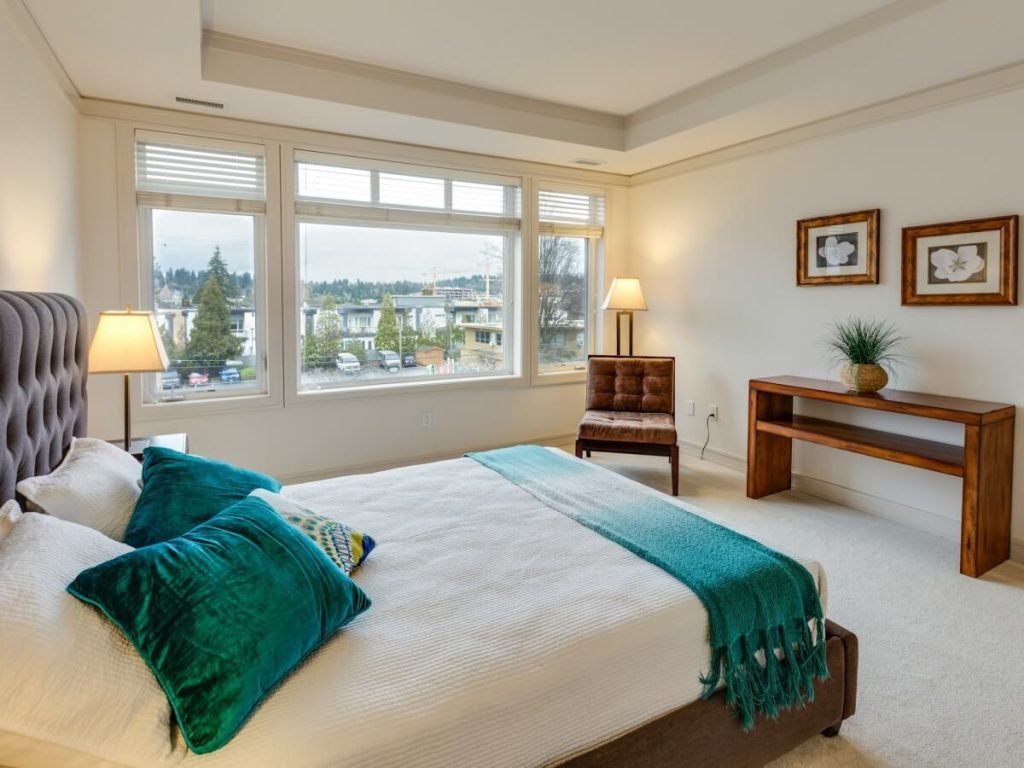
- 90–120 square feet (roughly 10′ x 10′ to 10′ x 12′): This is the sweet spot. A queen fits with real clearance on at least one side, and there’s usually still room for a slim nightstand or a narrow dresser. Most “small but manageable” bedrooms fall here.
- Under 80 square feet: This is where a queen usually stops making sense. You’re better off with a full or a well-chosen twin XL — see the bed sizing table in the full guide for exact comparisons.
5 Ways to Make a Queen Bed Work in a Tight Room
If your room falls in that “tight but possible” zone, these adjustments make the biggest difference:
1. Push the bed against the wall (yes, really). Placing one long side against the wall frees up an entire side of clearance for the room’s main walkway. It’s a small mental shift for a big functional gain — and it’s one of the most common questions we get from first-apartment renters.
2. Skip the footboard, and rethink the headboard. A frame with no footboard shortens the usable footprint even though the mattress size stays the same. A slim or wall-mounted headboard (rather than a bulky upholstered one) can reclaim several inches too.
3. Go vertical with storage instead of horizontal. Swap a wide dresser for a tall, narrow one. Use wall-mounted shelves instead of a nightstand with a wide base. Every inch you take off the floor is an inch back in your walkway.
4. Use furniture with visual lightness. Bed frames with exposed legs, glass-top tables, and open shelving all make a snug room read as airier — even though the square footage hasn’t changed. This matters more than people expect; a heavy, boxy bed frame can make an already-tight room feel smaller than it is.
5. Let go of the matching nightstand pair. One full-size nightstand and one slim wall shelf or floating ledge on the other side is a classic small-space trick. You keep function on both sides of the bed without needing 12+ inches of floor space twice.
When a Queen Isn’t the Right Call
If your room is under roughly 80 square feet, or if a queen would leave you with less than 18 inches of clearance anywhere, it’s worth being honest with yourself: a full-size bed (54″ x 75″) gives up surprisingly little sleeping space while giving back a meaningful amount of room. For a single sleeper, a twin XL (38″ x 80″) can free up enough floor space to add a small desk or reading chair — something a queen usually rules out entirely.
For queen bed in a small bedroom, there’s no prize for forcing a queen into a room that can’t comfortably hold it. The goal is a bedroom that works for you, not a bedroom that technically fits the biggest bed you own.
The Bottom Line
A queen bed in a small bedroom can absolutely work — plenty of first apartments prove it every day. The difference between a queen that feels right and one that feels like a mistake almost always comes down to clearance, not just square footage. Measure first, choose your layout second, and let the numbers (not the showroom photos) make the call. Want the full framework for planning every part of a small bedroom — not just the bed? Check out our Complete Small Bedroom Design Guide for room diagnosis, lighting, storage, and decor strategies.